





In the Solar System, for example, planetary magnetic fields can be detected by moving a probe through them. For example, Voyager 1 made these measurements on Jupiter and Saturn decades ago. Your magnetometer is one of the last instruments still active on board this ancient probe, that is currently traveling at the edge of the solar system. This option is not given to an exoplanet, so indirect methods are required.
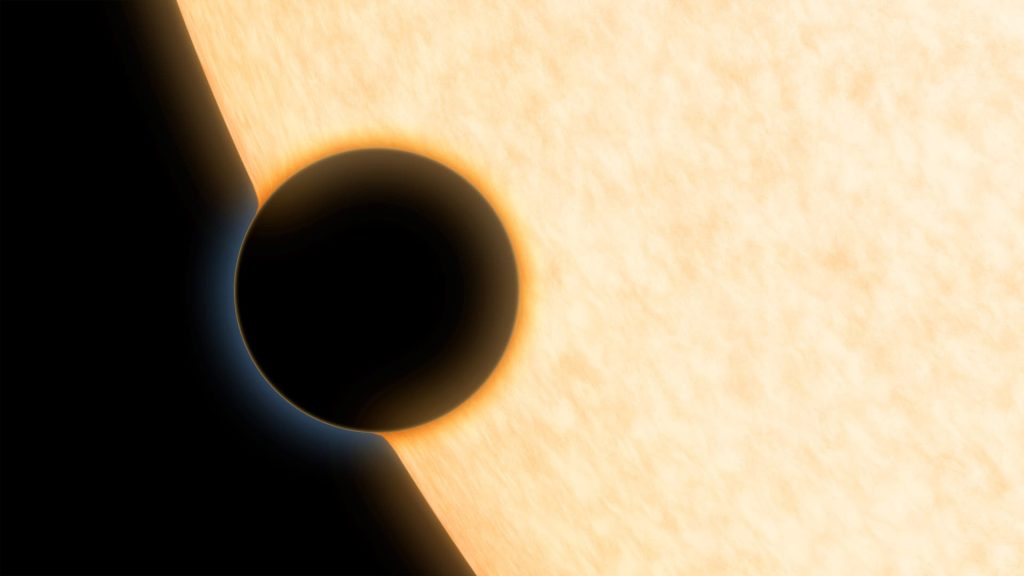
With one of these, a team of researchers has now succeeded in detecting signs of a magnetic tail in exoplanet HAT-P-11b and assessing the strength of its magnetic field. HAT-P-11b is located about 123 light-years away in the constellation Swan and orbits a dwarf star called HAT-P-11. When it was discovered in 2009, it was the smallest known planet Found by ground-based telescopes using the transit method. It’s about the size of Neptune, but it doesn’t orbit its star at an icy distance, but is so close that it only takes five days to make one orbit.
“Warm Neptune”
A group about Lotfi Bengavel of the Sorbonne in Paris is now describing details of his suspected magnetic field. in Nature Astronomy. The researchers used ultraviolet images taken by the Hubble Space Telescope when the planet was passing in front of its central star from Earth’s perspective. By examining the light with a spectrophotometer, they were able to find evidence of hydrogen and ionized carbon.
Both elements were detectable for a short time after the transit, when the planet itself had already completely left the star’s disk. This means: that the two components were apparently not in the atmosphere of the planet, but in its atmosphere magnetosphere – More precisely: in its magnetic tail. On the side facing away from the star, the magnetosphere extends much further into space because it is not compressed by stellar winds as it is on the side facing the star.

Sylvia Plath writes for Social Post News, covering news, politics, business, technology, sport, entertainment, and lifestyle. She focuses on clear, reliable reporting and useful information, helping readers stay informed about current events, emerging trends, and stories that matter.




More Stories
Google Pauses AI Image Generation in Google Earth After Less Than 48 Hours
Bumblebees Show Problem-Solving Skills Once Thought Limited to Larger-Brained Animals
Artemis 2’s Orion Heat Shield Faces Critical Test as Astronauts Prepare for Fiery Earth Reentry