






© NASA/JPL-Caltech/SwRI/MSSS
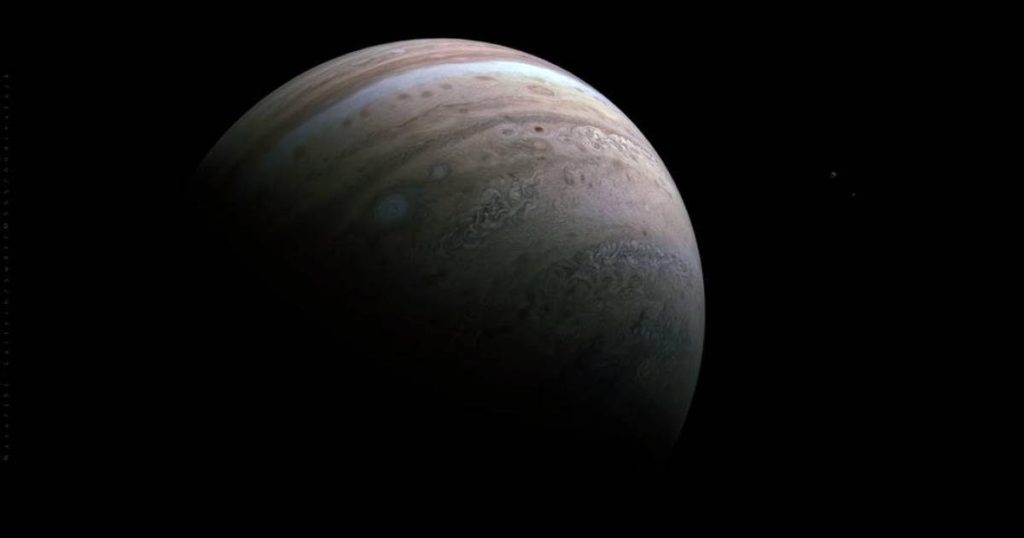
Great image from NASA’s spacecraft Juno On January 12th, the southern hemisphere of Jupiter appears. When zoomed in, the moons of Jupiter are shown in the right frame Yes (left) and Europe (Right) Clearly visible.
At the time of recording, the spacecraft was about to 61,000 km away from Jupiter. The JunoCam Raw Data It was before a world Andrea Lack processed.
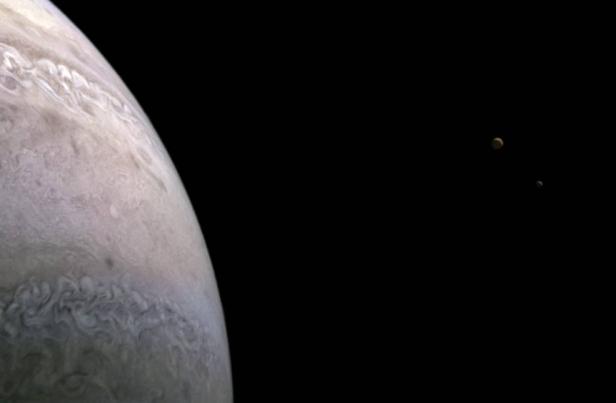
Enlarged section of the image. The points in the image are Io (left) and Europa (right).
© NASA / JPL-Caltech / SwRI / MSSS / Andrea Luck
Europe can harbor liquid water
IU Ho According to NASA The most volcanically active celestial body in the solar system. Hundreds of volcanoes cover the surface of Io, producing lava flows and sulfur eruptions at an altitude of hundreds of kilometers. 1979, volcanic activity of the spacecraft Voyager 1 registered.
Europa, on the other hand, is the smallest of Jupiter’s four moons. The researchers hypothesize that it contains an ocean of liquid water under the ice sheet at the surface. Using the many science instruments on board, Juno is expected to provide more details about Europa in September, when the probe has approached the moon for decades.
In late 2023 and early 2024, Juno will be especially close to Jupiter’s moon Io. The mission is scheduled to end in September 2025.

Sylvia Plath writes for Social Post News, covering news, politics, business, technology, sport, entertainment, and lifestyle. She focuses on clear, reliable reporting and useful information, helping readers stay informed about current events, emerging trends, and stories that matter.




More Stories
Google Pauses AI Image Generation in Google Earth After Less Than 48 Hours
Bumblebees Show Problem-Solving Skills Once Thought Limited to Larger-Brained Animals
Artemis 2’s Orion Heat Shield Faces Critical Test as Astronauts Prepare for Fiery Earth Reentry