





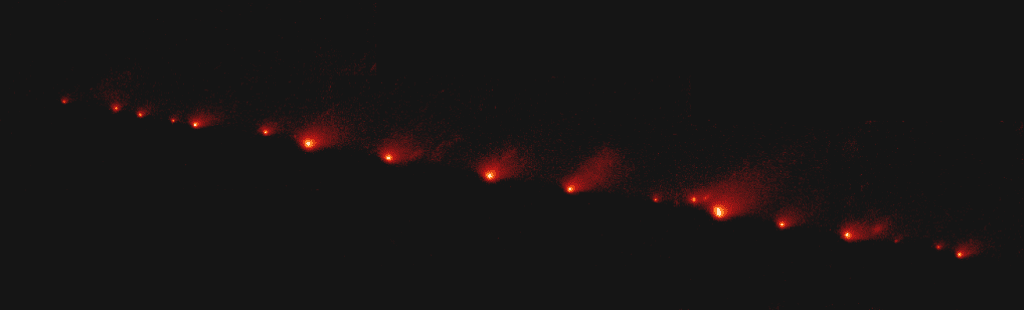

At first there was nothing to see on Earth. It wasn’t until nine months later that Caroline, Eugene Shoemaker, and David Levy discovered a string of unusual comets in one of the images.
It soon became clear that these objects were orbiting Jupiter. Orbit analyzes showed that the comet fragments, named after the discoverers, would no longer cross the planet in July 1994, but would fall into it.
Experts had never before been able to follow such a cosmic collapse. The comet’s fragments raced through the planet’s clumps of gases over the course of six days. It was previously unclear whether the pieces, which at best were a thousand meters in size, could leave any visible traces at all.
you may. The chain collision exceeded all expectations: every hit caused an explosion. The “scars” can be seen in Jupiter’s atmosphere for weeks – even in amateur telescopes. The Hubble Space Telescope, which was still quite new at the time, made its world-wide acclaim.
But for Comet Shoemaker-Levy 9 that was the end. The comet was simply “unlucky” to have been captured by Jupiter and propelled into its deadly orbit over the course of a few decades. In turn, he presented astronomy fans with a unique spectacle.

William Faulkner writes for Social Post News, covering news, politics, business, technology, sport, entertainment, and lifestyle. He focuses on clear, reliable reporting and useful information, helping readers stay informed about current events, emerging trends, and stories that matter.




More Stories
Google Gemini Downgrade Draws Criticism as Survey Shows Users Oppose New AI Restrictions
Google Gemini Expands Connected Apps With Adobe, Airtable, Peloton and More
OpenRGB 1.0 Expands Open-Source RGB Control Across Windows, Linux and macOS