




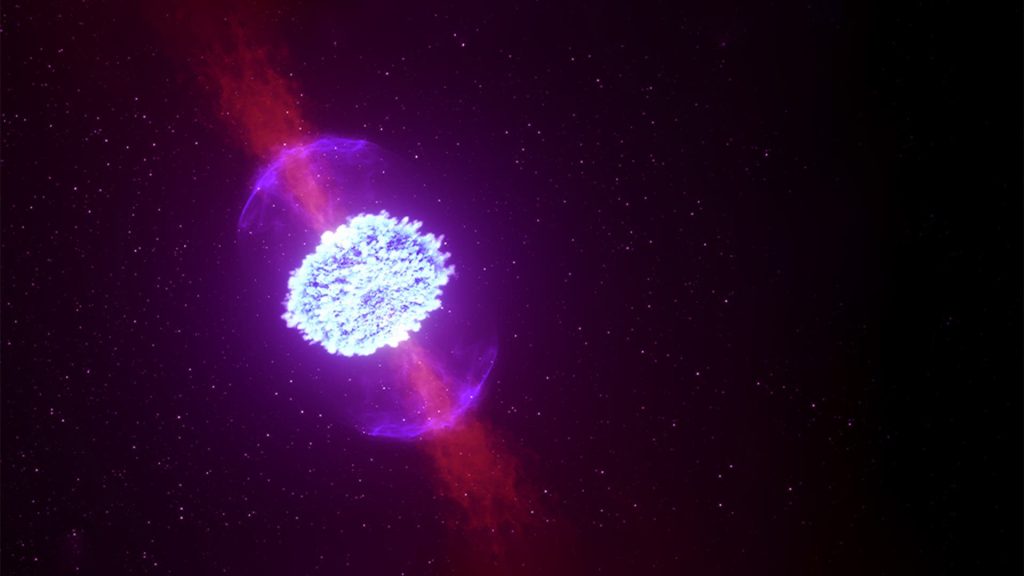
GRB 211211A could change the worldview of astronomers – at least with regard to the formation of gamma-ray bursts. NASA’s Swift research satellite recorded this gamma-ray burst signal on December 11, 2021, and a team led by Jun Yang of Nanjing University in China analyzed this data and fed it into a model. The scientists published their findings in »natural astronomy” And the “nature«.
A single gamma-ray burst lasts a long time, which is typical for a starburst, while the merger of two neutron stars lasts only a few seconds. The duration of GRB 211211A suggested a supernova, but other properties suggested the second option. Similar gamma-ray bursts have been observed before, but not yet identified. So, when Swift detected this outburst, many working groups devoted themselves to the flash using additional detectors and telescopes. This enabled them not only to analyze the gamma radiation emitted, but also to examine light, ultraviolet and X-rays.
With this data, they were able to show that the flash lasted 13 seconds. A second flare followed, now lasting 55 seconds, before another burst of high-energy gamma rays appeared 16 minutes later, lasting a full five hours. Yang and his colleagues fed this data into a model to figure out where the lightning came from.

Sylvia Plath writes for Social Post News, covering news, politics, business, technology, sport, entertainment, and lifestyle. She focuses on clear, reliable reporting and useful information, helping readers stay informed about current events, emerging trends, and stories that matter.



More Stories
Google Pauses AI Image Generation in Google Earth After Less Than 48 Hours
Bumblebees Show Problem-Solving Skills Once Thought Limited to Larger-Brained Animals
Artemis 2’s Orion Heat Shield Faces Critical Test as Astronauts Prepare for Fiery Earth Reentry