





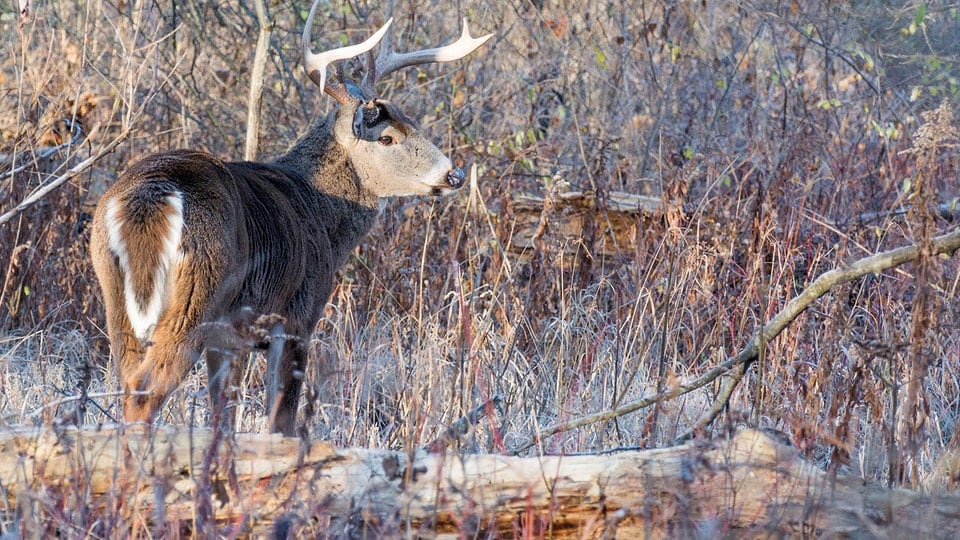
US researchers have often detected coronavirus in samples from white-tailed deer. It has passed from humans to animals many times – and soon evolved into them.
experts from Ohio State University For their study, they examined a total of 1,522 nasal swabs from free-roaming white-tailed deer throughout Ohio from November 2021 to March 2022. More than ten percent of the samples tested positive for Sars-CoV-2. Subsequent genome analysis showed that at least 30 infections originated in human vectors – a surprisingly high number. Also unexpected was the speed at which the pathogen continued to evolve in animals, about three times as fast as it did in humans.
“Traditionally, interspecies transfers have been viewed as rare events,” explains study author Andrew Bowman. “But our sample was not a large sample and we were able to document 30 transmissions in it alone.” This indicates that the virus could jump back and forth between humans and animals faster than previously thought. And the transmission route is not a one-way street either, because apparently people also contracted MERS-CoV from deer.
The study also showed that COVID-19 vaccines may also protect against dangerous diseases when animals become infected in humans. This can be demonstrated using Siberian hamsters, where vaccinated animals became less dangerous than unvaccinated animals. Hamsters are often used as a model species in SARS-CoV-2 studies. Ultimately, novel coronavirus variants can also evolve in wild animals, which is why these scenarios must also be taken into account when monitoring SARS-CoV-2, as scientists demand.

Sylvia Plath writes for Social Post News, covering news, politics, business, technology, sport, entertainment, and lifestyle. She focuses on clear, reliable reporting and useful information, helping readers stay informed about current events, emerging trends, and stories that matter.




More Stories
Google Pauses AI Image Generation in Google Earth After Less Than 48 Hours
Bumblebees Show Problem-Solving Skills Once Thought Limited to Larger-Brained Animals
Artemis 2’s Orion Heat Shield Faces Critical Test as Astronauts Prepare for Fiery Earth Reentry