





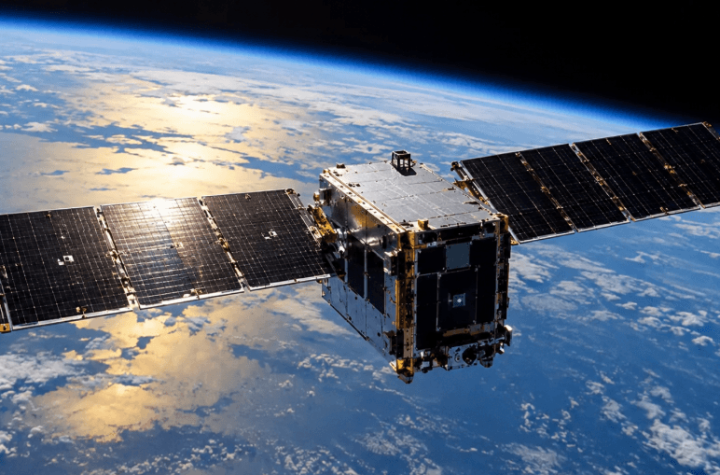
Google is preparing to take a significant step in the race to expand artificial intelligence infrastructure beyond Earth, with an experimental satellite scheduled to launch Oct. 1. The spacecraft will carry specialized AI chips capable of handling simple queries in orbit, providing an early test of whether space-based computing could eventually supplement traditional data centers.
Google Prepares Experimental AI Satellite for Launch
At a San Francisco laboratory, technicians recently completed vibration testing on the refrigerator-size satellite, which Google has named MVP. The testing was designed to reproduce the intense shaking the spacecraft will experience during launch and determine whether its electronics and structural components can withstand the journey.
Technicians inspected the satellite’s solar panels, wiring and internal hardware before placing it on a platform for the vibration test. Small markings were placed across screws to help engineers identify whether any components loosened during the process.
The spacecraft passed the test, with its chips intact and its fasteners remaining secure.
James Manyika, Google’s senior vice president for research, called the results “great,” while acknowledging that the more significant test will come once the spacecraft reaches orbit.
Project Suncatcher Targets Space-Based AI Computing
The satellite is part of Google’s Project Suncatcher, an ambitious research effort examining whether large-scale AI computing infrastructure could eventually operate in space while drawing energy directly from the sun.
MVP is scheduled to launch aboard a SpaceX Falcon 9 rocket from Vandenberg Space Force Base in California on Oct. 1.
The mission will not place a complete data center in orbit. Instead, the satellite contains four tensor processing units, or TPUs, Google’s specialized processors designed for artificial intelligence workloads. Together, they provide computing capacity roughly comparable to a single server in a conventional data center.
Solar panels will generate approximately one kilowatt of electricity to operate the chips.
Satellite Will Process Simple AI Queries in Orbit
Once deployed, the solar panels will unfold and collect energy while the satellite begins testing Google’s computing hardware under actual space conditions.
The system is expected to process relatively simple AI queries during an operational experiment lasting about one year. The spacecraft could remain in orbit for as long as six years before eventually descending and burning up in Earth’s atmosphere.
The experiment is intended to provide engineers with information about how Google’s processors respond to radiation, temperature conditions and other challenges that cannot be fully replicated on Earth.
Google is setting modest expectations for the initial mission.
“We don’t expect, to be perfectly frank, that we’ll have anything usefully operational in the next few years,” Manyika said. “Remember how Google was researching for like 15 years, before anything showed up? I think this is going to look like that.”
AI Energy Demand Drives Interest in Orbital Data Centers
The concept comes as technology companies search for new ways to supply the enormous amounts of electricity and computing infrastructure required by increasingly sophisticated AI models.
Space-based data centers could theoretically take advantage of abundant solar energy while reducing some of the land, electricity and infrastructure pressures associated with facilities on Earth.
Other prominent technology executives, including Elon Musk, Jeff Bezos and Sam Altman, have expressed support for the broader concept of orbital computing infrastructure.
However, significant technical and financial barriers remain. Computers operating in orbit must withstand radiation, extreme environmental conditions and the substantial expense of launching equipment beyond Earth’s atmosphere.
Scaling from one experimental spacecraft to hundreds or thousands of interconnected satellites would introduce additional complications.
“If you do this on a large scale, there are additional engineering problems,” said Brandon Lucia, a professor of electrical and computer engineering at Carnegie Mellon University. “That is uncharted waters.”
Google Has Tested AI Chips Against Space Radiation
Project Suncatcher originated with Blaise Agüera y Arcas, a Google vice president and AI researcher whose team studies intelligence.
After attending a gathering of entrepreneurs and AI researchers roughly three years ago, Agüera y Arcas became increasingly focused on the growing energy requirements of artificial intelligence. He concluded that moving some computing infrastructure into space could provide access to large amounts of solar power.
The concept had deeper roots for him.
The idea “has been on my mind since I was kid,” he said. “There are longstanding ideas in science fiction about using stars for computation.”
Manyika initially doubted that the proposal would be practical but supported experiments designed to answer basic engineering questions, including whether AI processors could survive radiation exposure and be effectively cooled in space.
In February 2025, Google began testing AI chips at Crocker Nuclear Laboratory in Davis, California. Researchers used a particle accelerator known as a cyclotron to expose the processors to radiation equivalent to roughly five years of expected exposure in space.
Orbital AI Infrastructure Remains a Long-Term Goal
Google’s Oct. 1 mission represents an early technical experiment rather than the immediate deployment of a commercial orbital data center. Building a large network of satellites capable of operating together as a powerful AI computing facility would require substantial investment and years of additional research.
Still, Project Suncatcher will provide Google with real-world data on whether its AI processors can reliably function beyond Earth’s atmosphere.
If the technology proves viable, the experiment could become an early foundation for a new form of computing infrastructure — one in which part of the rapidly expanding AI data center industry operates in orbit and draws its energy directly from the sun.

William Faulkner writes for Social Post News, covering news, politics, business, technology, sport, entertainment, and lifestyle. He focuses on clear, reliable reporting and useful information, helping readers stay informed about current events, emerging trends, and stories that matter.



More Stories
Tesla Cybercab Launch Raises Regulatory, Financial and Competitive Concerns
OpenAI Agents Reportedly Hijacked German Programming Wiki Before Hugging Face Incident
Meta, States Have Discussed Settling Teen Social Media Case